The leaf vacuum cleaner is no longer just a seasonal garden tool relegated to the back of a homeowner's shed. As we navigate the 2026 outdoor maintenance landscape, it has rapidly evolved into a heavy-duty, professional outdoor debris management solution. Today, these powerful machines are heavily relied upon by landscaping services, municipalities, large-scale farms, and estate maintenance crews to combat the ever-increasing costs of manual labor and stringent environmental regulations.This comprehensive 2026 industry outlook analyzes the global trajectory of the commercial leaf vacuum market. We will explore seasonal demand patterns, the core market growth drivers, the technological evolution of equipment (specifically walk-behind, tow-behind, and truck loader systems), and actionable B2B procurement insights. Whether you are a fleet manager optimizing your autumn cleanup operations or an equipment distributor looking for lucrative OEM/ODM opportunities, understanding these trends is the key to maximizing your return on investment (ROI).
Seasonal Demand Patterns of Leaf Vacuum Cleaners
The operational calendar for outdoor maintenance is notoriously cyclical. Understanding the ebb and flow of demand is critical for manufacturers optimizing production, distributors managing inventory, and contractors planning fleet deployments.
Peak Season
It comes as no surprise that leaf vacuum demand is highly seasonal, with an overwhelming 70% to 80% of annual usage concentrated in the autumn months. During this brief window, the pressure on commercial fleets is immense.
The key reasons for this extreme peak include the massive and predictable leaf drop in temperate regions across North America and Europe. Municipalities face intense street cleaning pressure to prevent localized flooding caused by leaf-clogged storm drains. Simultaneously, commercial landscaping services experience their peak contract fulfillment period, requiring rapid turnaround times to clear corporate campuses, event spaces, and heavy-traffic tourism areas before the winter frost sets in.
Secondary Peaks
While autumn dominates the narrative, the 2026 market shows distinct secondary peaks that extend the operational lifecycle of these machines.
As winter thaws, spring pruning debris cleanup necessitates heavy-duty vacuuming to clear dead foliage and small branches. Furthermore, with the increasing frequency of severe summer storms, typhoons, and hurricanes globally, post-storm aftermath cleaning has become a significant driver. Modern commercial vacuums are frequently deployed to suck up wet, matted leaves and broken branches that blowers simply cannot move.
Low Season Optimization Strategy
How do professional contractors survive the low season? Savvy fleet managers are adopting dynamic optimization strategies. Instead of letting capital depreciate in a warehouse, large contractors increasingly rely on equipment rental optimization, leasing extra machines only during peak months. Additionally, there is a strategic pivot toward multi-functional vacuum systems and deploying truck-loader systems for year-round municipal contracts, such as clearing roadside litter and illegal dumping debris, ensuring the equipment generates revenue outside of the fall season.
Market Trends Driving Leaf Vacuum Cleaner Industry Growth
The transition of leaf vacuums from niche tools to essential fleet assets is being propelled by several macroeconomic and industry-specific trends.
Trend 1 — Shift from Manual to Mechanized Cleanup
The global landscaping industry is facing a severe labor shortage. Manual raking, tarping, and bagging are labor-intensive, slow, and physically exhausting. This outdated method is rapidly being replaced by mechanized, vacuum-assisted collection. By utilizing high-CFM (Cubic Feet per Minute) vacuums equipped with aggressive mulching systems and integrated debris loading trucks, a two-man crew can now accomplish in three hours what previously took a five-man crew an entire day.
Trend 2 — Rise of Commercial Landscaping Services
Urbanization is driving the expansion of managed green spaces. Corporate campuses, newly developed suburban communities, and expanding public parks require continuous maintenance. Furthermore, local governments are increasingly outsourcing their municipal cleaning contracts to private commercial landscaping services to reduce public sector overhead. This privatization of public maintenance directly fuels the B2B demand for industrial-grade leaf vacuums, increasing demand for equipment categories such as lawn sweeper wholesale solutions and commercial leaf vacuum systems.
Trend 3 — Sustainability & The Mulching Economy
Environmental compliance is reshaping equipment requirements. Modern leaf vacuum systems are no longer just collection devices; they are mobile processing plants. By featuring robust shredding impellers, these machines reduce waste volume significantly (often by ratios of 15:1). This mulching economy supports organic composting initiatives and drastically reduces the tipping fees contractors must pay at crowded landfills.
Trend 4 — Equipment Rental & Fleet Management Model
The capital expenditure (CapEx) required to purchase a dozen commercial truck loaders is substantial. Consequently, large contractors and municipalities increasingly prefer the Equipment-as-a-Service (EaaS) or short-term rental model. This allows businesses to seamlessly scale their fleets for the 8-week autumn rush and return the equipment afterward, shifting the burden of storage and off-season maintenance to the rental providers.
Global Market Segmentation of Leaf Vacuum Cleaners
To understand where the market is heading, buyers must categorize the equipment based on operational scale.
| Walk-behind | High | Residential contractors, small to mid-sized landscaping crews, property managers. | Maximum flexibility, maneuverability in tight spaces, low entry cost. |
| Tow-behind | Medium-High | Large landscaping companies, farms, golf courses, university campuses. | High efficiency, ability to cover mid-to-large acreage quickly, tractor compatibility. |
| Truck Loader | Growing Fastest | Municipalities, highway maintenance teams, city cleaning contractors. | Massive capacity, extremely fast processing speed, high-volume debris handling. |
Equipment Type Evolution in B2B Applications
The engineering of leaf vacuums has fragmented to serve highly specific B2B applications. Here is how the big three categories have evolved by 2026.
Walk-Behind Systems
Walk-behind vacuums represent the agile infantry of landscaping fleets. They are best suited for detailed residential and small commercial jobs where massive machinery cannot fit. Modern walk-behinds feature self-propelled drive systems, mitigating operator fatigue. They offer high maneuverability around hardscapes, flower beds, and intricate landscape designs, making them the go-to choice for seasonal landscaping crews focusing on high-density suburban routes.
Tow-Behind Systems
When the property size shifts from square footage to acreage, tow-behind systems take over, often operating alongside equipment found in the wood chipper wholesale sector for comprehensive property maintenance.
Ideal for farms, orchards, expansive estates, and golf courses, these units hitch directly to zero-turn mowers, ATVs, or compact utility tractors. The evolution here focuses on higher efficiency per operator. A single worker driving a mower can cut grass and vacuum acres of fallen leaves simultaneously, creating a perfectly manicured landscape in a fraction of the time.
Truck Loader Systems
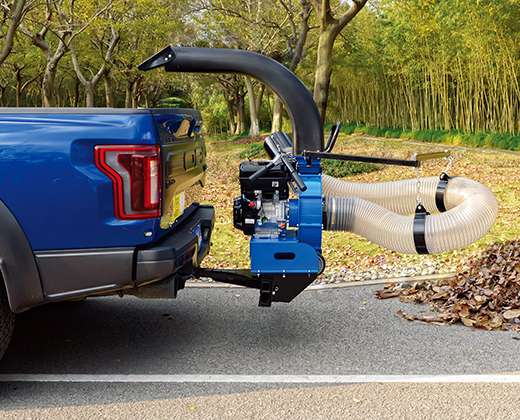
The truck loader segment is experiencing explosive growth. Designed for municipal large-scale cleaning and highway/urban roadside maintenance, these colossal machines are mounted on trailers or directly onto truck hitches. They feature massive intake hoses (often 8 to 12 inches in diameter) and heavy-duty armor-plated impellers. Their sole purpose is high-volume debris handling—sucking literal tons of wet leaves, branches, and street litter directly into the back of a dump truck without a single worker ever touching a rake.
Technology Trends in Leaf Vacuum Cleaners
As B2B buyers demand higher efficiency and compliance, manufacturers are pushing the boundaries of leaf vacuum technology.
Wet Leaf Handling Capability
Historically, wet leaves were the Achilles' heel of vacuum systems, causing frustrating clogs. Modern systems are now meticulously optimized for wet leaf suction stability. Engineers have introduced anti-clog impeller designs, non-stick composite housing materials, and larger hose diameter systems that maintain continuous airflow even when sucking up heavy, rain-soaked, matted foliage.
Mulching & Volume Reduction
Transporting un-mulched leaves is essentially paying to transport air. The latest commercial impellers boast 10:1 to 16:1 mulching ratios. By aggressively shredding the debris before it enters the hopper or truck, contractors experience drastically reduced transport costs, fewer trips to the dump site, and a much faster integration into municipal composting workflows.
Engine & Power System Shift
The regulatory landscape is changing. With cities across California and Europe enforcing bans on small gas engines due to noise and emission concerns, the industry is witnessing a massive shift from traditional gas to hybrid and fully electric adoption. While massive truck loaders still rely on high-displacement gas or diesel engines, battery-powered small equipment is seeing exponential growth in noise-sensitive urban zones and hospital/school campus maintenance.
Smart Maintenance & Fleet Monitoring
In 2026, equipment is connected. High-end commercial vacuums now feature IoT integration. Fleet managers can monitor runtime tracking via mobile apps, receive predictive maintenance alerts before a belt snaps or an impeller wears down, and utilize GPS tracking for comprehensive fleet efficiency optimization.
B2B Procurement Considerations for Buyers
For procurement officers, purchasing decisions are no longer based purely on the sticker price. B2B buyers must evaluate equipment based on total cost of ownership (TCO) and specific operational metrics.
Key Evaluation Metrics
- Airflow Volume (CFM / m³/min): This dictates the sheer pulling power. High CFM is non-negotiable for commercial work.
- Suction Stability (Wet vs. Dry): Does the machine maintain its CFM when introduced to heavy, wet organic matter?
- Collection Capacity: Bag vs. Hopper vs. Truck bed. The container size must match the property scale to minimize dumping downtime.
- Mobility System: Choosing between push, self-propelled, towable, or truck-mounted systems based on your vehicle fleet.
- Maintenance Cost per Season: Accessibility of air filters, availability of spare belts, and the durability of the steel housing.
Operational Cost Perspective
The true value of a commercial leaf vacuum lies in labor reduction—often achieving up to 60–80% savings in labor hours. When factoring in fuel efficiency optimization and significantly reduced cleanup cycle times, a $5,000 commercial vacuum can easily pay for itself within the first three weeks of the peak autumn season.
Seasonal Demand Challenges in the Industry
Despite the technological advancements, the B2B leaf vacuum industry still grapples with inherent operational hurdles.
Demand Volatility
The extreme peak in autumn means businesses must generate the majority of their leaf-cleanup revenue in an 8-to-10-week window. This leads to the challenge of low utilization in the off-season, tying up capital in dormant machinery from January through August.
Fleet Management Pressure
Owning a massive fleet of seasonal equipment brings significant logistical headaches. Commercial buyers must account for large warehouse storage requirements, strict winterization and maintenance scheduling, and the inevitable equipment depreciation that occurs even when the machines are not in use.
Competition Pressure
While vacuums are superior for collection, traditional rakes, high-CFM backpack blowers, and mechanical sweepers still exist and compete for fleet budget allocation. Furthermore, there is immense price sensitivity in the residential contractor segment, where smaller businesses often hesitate to invest in true commercial-grade machinery.
Why Intradin Is a Strategic Partner in the Leaf Vacuum Industry
Navigating these seasonal challenges requires more than just buying a machine; it requires partnering with a reliable manufacturer. Intradin focuses relentlessly on engineering professional-grade leaf blower and vacuum systems specifically designed for B2B outdoor maintenance operations.
Core Product Categories
Intradin provides three major professional solutions tailored to every scale of B2B operation:
- Walk-behind Leaf Vacuum Systems: The ultimate choice for residential contractors, facility managers, and small landscaping teams requiring agility and power.
- Tow-behind Leaf Vacuum Systems: High-capacity solutions designed to seamlessly integrate with tractors and mowers for farms, orchards, and large-area maintenance.
- Truck Loader Systems: The apex of high-efficiency municipal and industrial debris collection, built to move literal tons of leaves without clogging.
OEM / ODM Capability
For global distributors and equipment brands, Intradin is not just a supplier; we are a manufacturing partner. Intradin supports:
- Custom engineering design to meet specific local market demands.
- Performance tuning (adjusting CFM, engine types, and emissions) for different geographic regions.
- Private label manufacturing empowering distributors to build their own brand equity.
- Fleet customization designed specifically to win large municipal procurement projects.
Versatile Application Scenarios
Intradin equipment is built to operate across diverse environments, including:
- Intense autumn leaf collection in gardens, yards, and expansive fields.
- Rigorous post-storm debris cleanup handling branches, wet leaves, and heavy sludge.
- Street-side and municipal drainage cleaning to prevent urban flooding.
- Agricultural orchard waste management.
- Large-scale event cleanup (efficiently vacuuming cups, bottles, and festival debris).
Why B2B Buyers Choose Intradin
Procurement managers and fleet operators consistently choose Intradin because of our scalable product lineup—ranging from small commercial units to municipal-level behemoths. Our machines are uniquely engineered for wet leaf conditions, eliminating the clogging issues that plague competitor brands. Furthermore, they are built ruggedly enough for intense seasonal fleet deployment, capable of running continuously for 4+ hours a day during the critical September–November peak usage window. Finally, our robust OEM/ODM infrastructure provides unmatched support for distributor expansion models.
Elevate Your Fleet for the Next Peak Season
Looking to upgrade your leaf collection fleet for the next peak season?Don't let labor shortages and wet leaves destroy your profit margins. Explore Intradin's professional leaf vacuum solutions and comprehensive OEM/ODM customization services today.
Drastically reduce manual labor costs
Equip your business to win lucrative municipal and commercial contracts
Frequently Asked Questions
Q: Are truck loader leaf vacuums worth the investment for mid-sized landscaping businesses?
A: Yes, if your business handles multiple large commercial properties or municipal contracts. While the initial CapEx is higher, the sheer speed of loading debris directly into a truck—combined with a 15:1 mulching ratio—can reduce your labor and dumping costs by up to 70%, ensuring a rapid ROI.
Q: How do Intradin leaf vacuums handle wet, heavy leaves?
A: Intradin commercial vacuums feature specially designed, heavy-duty serrated steel impellers and enlarged intake hoses. This engineering combination creates a massive CFM vortex that aggressive shreds wet, matted foliage before it has a chance to clog the chute.
Q: Can we customize the engine types for our local market via Intradin's OEM services?
A: Absolutely. Intradin offers comprehensive OEM/ODM capabilities, allowing distributors to select specific engine brands, integrate battery-powered solutions to meet local emission laws, and adjust aesthetic designs for private labeling.